

• 0207 164 6821
  • enquiries@npsych-rehab.com
Children’s Mental Health Week – early specialist assessment for children and adolescents

Children’s Mental Health Week: Early Support and Assessment Can Change Life Trajectories

Every child develops at their own pace. Some are naturally quiet and reflective; others are energetic, curious and constantly on the move. Differences in attention, emotional regulation, learning, or social interaction are often part of typical development.

However, when these differences begin to affect a child’s wellbeing, education, or relationships, early understanding becomes essential.

Children’s Mental Health Week is a reminder that mental health in childhood is not a “later” issue, it is foundational. The patterns shaped in early years can influence outcomes across adolescence and adulthood.

Why early support matters

Early identification and timely support are consistently linked with better long-term psychological, educational and social outcomes. When difficulties are recognised early:

  • Children gain insight into how their minds work
  • Parents receive clarity and practical guidance
  • Schools can put appropriate support in place
  • Early strategies can reduce escalation in adolescence

Without early understanding, some children begin to internalise difficulties. Over time, this may affect confidence, self-esteem, identity, school engagement and emotional wellbeing.

Early support and assessment can change life trajectories.

Why early specialist assessment can be so helpful

Early specialist assessment helps us understand how a child thinks, learns, and manages emotions, allowing support to be tailored to their needs, rather than relying on generic strategies or guesswork.

Importantly, it brings together the cognitive and emotional picture. Understanding a child’s memory, attention, learning style, and emotional wellbeing helps professionals see the whole child, not just individual difficulties.

By looking at how children think, feel, and interact with others, support can be built around their unique strengths and needs. When cognitive skills and emotional regulation are considered together, children are more likely to receive the right help at the right time.

At NPsych, our assessment work sits within our broader Neuropsychology and Mental Health services, ensuring recommendations translate into practical support and meaningful outcomes.

When might an assessment be helpful?

Parents often notice subtle signs long before concerns are formally raised. An assessment may be helpful if you’re seeing:

  • Persistent anxiety or heightened worry
  • Intense emotional reactions or difficulties with regulation
  • Attention, impulsivity or hyperactivity that disrupts daily life
  • Social communication challenges or friendship difficulties
  • Learning, memory, or processing concerns
  • Behaviour changes following trauma, stress, or significant transitions

Seeking an assessment doesn’t mean something is “wrong”. It means you are seeking clarity.

A thorough neuropsychological or psychological assessment can help identify strengths, understand challenges, and guide appropriate support at home and at school.

Supporting parents as well as children

Parents frequently tell us that uncertainty is the hardest part. Not knowing whether a behaviour is developmental, situational, or something more persistent can be stressful, especially when you’re trying to do the right thing.

Assessment provides answers and answers reduce uncertainty.

Early support isn’t about labels. It’s about understanding what a child needs, building tailored strategies, and helping them feel supported rather than misunderstood.

A proactive approach: assessment, formulation, intervention and review

Children’s Mental Health Week encourages us to move from reactive to proactive care. Instead of waiting for difficulties to intensify, early conversations and early assessment can offer direction and reassurance.

At NPsych, our work typically follows a structured pathway:

  • Assessment to understand cognitive, emotional and behavioural functioning
  • Formulation to make sense of what’s driving the difficulties, and what’s maintaining them
  • Intervention to put tailored strategies and therapy in place
  • Review to track progress, refine recommendations and ensure support remains aligned

Through careful assessment, personalised planning, and ongoing support, children can develop confidence and resilience over time.

Connecting families to the right specialist support

When concerns are identified early, families can be guided towards specialist services that offer in-depth assessment and tailored support, giving children the best opportunity to thrive at home, at school, and socially.

At NPsych, families can contact us directly to discuss concerns and explore the most appropriate next step. 

Because when support is provided early, the impact can last a lifetime.

If you’d like to explore whether an assessment could be helpful, please get in touch with NPsych and we’ll advise on the most appropriate next step.


Dementia is an umbrella term that describes a decline over time in cognitive functions such as memory, thinking skills, understanding and speech. Dementia has enormous, personal, societal and economic effects. According to NHS England (2024), 481,783 people have been diagnosed with dementia as of April 2024, and of those diagnosed, 33,711 received their diagnosis before the age of 65. The Alzheimer’s Society estimates that 900,000 people in the UK actually have dementia, which may rise to 1.6 million by 2040. Of the 900,000 people with dementia in the UK, over 78,000 are under the age of 65, and there are 25,000 from Black, Asian and minority ethnic groups. One in six people over the age of 80 has dementia.

What can EMDR offer people living with dementia and their carers?

#NPsychResearch: What can EMDR offer people living with dementia and their carers?

Some important new research out from the EMDR association regarding EMDR for people living with dementia and their carers. Also, well done to our very own Lucilla Carlacci De Mattia, who was one of the authors!

Dementia is an umbrella term that describes a decline over time in cognitive functions such as memory, thinking skills, understanding and speech. Dementia has enormous, personal, societal and economic effects. According to NHS England (2024), 481,783 people have been diagnosed with dementia as of April 2024, and of those diagnosed, 33,711 received their diagnosis before the age of 65. The Alzheimer’s Society estimates that 900,000 people in the UK actually have dementia, which may rise to 1.6 million by 2040. Of the 900,000 people with dementia in the UK, over 78,000 are under the age of 65, and there are 25,000 from Black, Asian and minority ethnic groups. One in six people over the age of 80 has dementia.

Read More…

New Insights into Social Development: How Infants Perceive Wealth

#NPsychPick of the Month: New Insights into Social Development: How Infants Perceive Wealth

A groundbreaking study by Arianne Eason et al. recently published in the Journal of Experimental Psychology: General delves into when and how infants begin to perceive wealth differences—and the behavioral changes that result. This research reveals the emergence of wealth-based biases as early as 15 months of age.

Key findings include:

  • Infants track wealth differences: By 15–18 months, children recognize cues of “rich” versus “poor” and exhibit a preference for wealthier individuals.
  • Behavior influenced by wealth cues: Across several experiments, toddlers were more likely to choose, help, and interact with actors perceived as wealthy.
  • Negative evaluations of poverty: Infants also linked negative attributes more readily to individuals with fewer resources, suggesting the emergence of evaluative biases.
  • Developmental timeline: Wealth-based biases were absent in younger infants (11–13 months), highlighting their developmental emergence during the second year of life.

From an evolutionary perspective, these findings might reflect adaptive strategies aimed at securing resources. However, they also underline how early societal inequalities can shape perceptions and interactions.

This research calls for critical reflection on how societal biases infiltrate developmental processes and the implications for fostering equity from an early age.

For further reading: Eason et al. (2024), The Haves and Have-Nots: Infants Use Wealth to Guide Social Behavior and Evaluation ????????

Read More Here…

Neurorehabilitation in brain tumours: evidences and suggestions for spreading of knowledge and research implementation

#NPsychPick of the Month: More evidence that early neurorehabilitation can improve the quality of life for brain tumour patients

Neurorehabilitation in brain tumours: evidences and suggestions for spreading of knowledge and research implementation via Current Opinion in Oncology.

Bartolo, M., Intiso, D., & Zucchella, C. (2023). Neurorehabilitation in brain tumours: evidences and suggestions for spreading of knowledge and research implementation. Current opinion in oncology, 35(6), 543–549.

Summary:

Drawing from the article “Neurorehabilitation in brain tumours: evidences and suggestions for spreading of knowledge and research implementation” by Bartolo, Intiso, and Zucchella, this review highlights the critical role of neurorehabilitation in addressing the sensory-motor and cognitive challenges caused by brain tumours and their treatments.

Key Takeaways:

  • Early evaluation through a multidisciplinary approach identifies diverse functional impairments.
  • Tailored rehabilitation programs address physical, cognitive, psychological, and social aspects, improving recovery and participation.
  • Collaborative care helps patients rebuild their lives and enhances their overall quality of life.

???? The Way Forward:

There’s a growing need to promote awareness of rehabilitation among neuro-oncologists and to drive high-quality research in this field.

Read More Here…

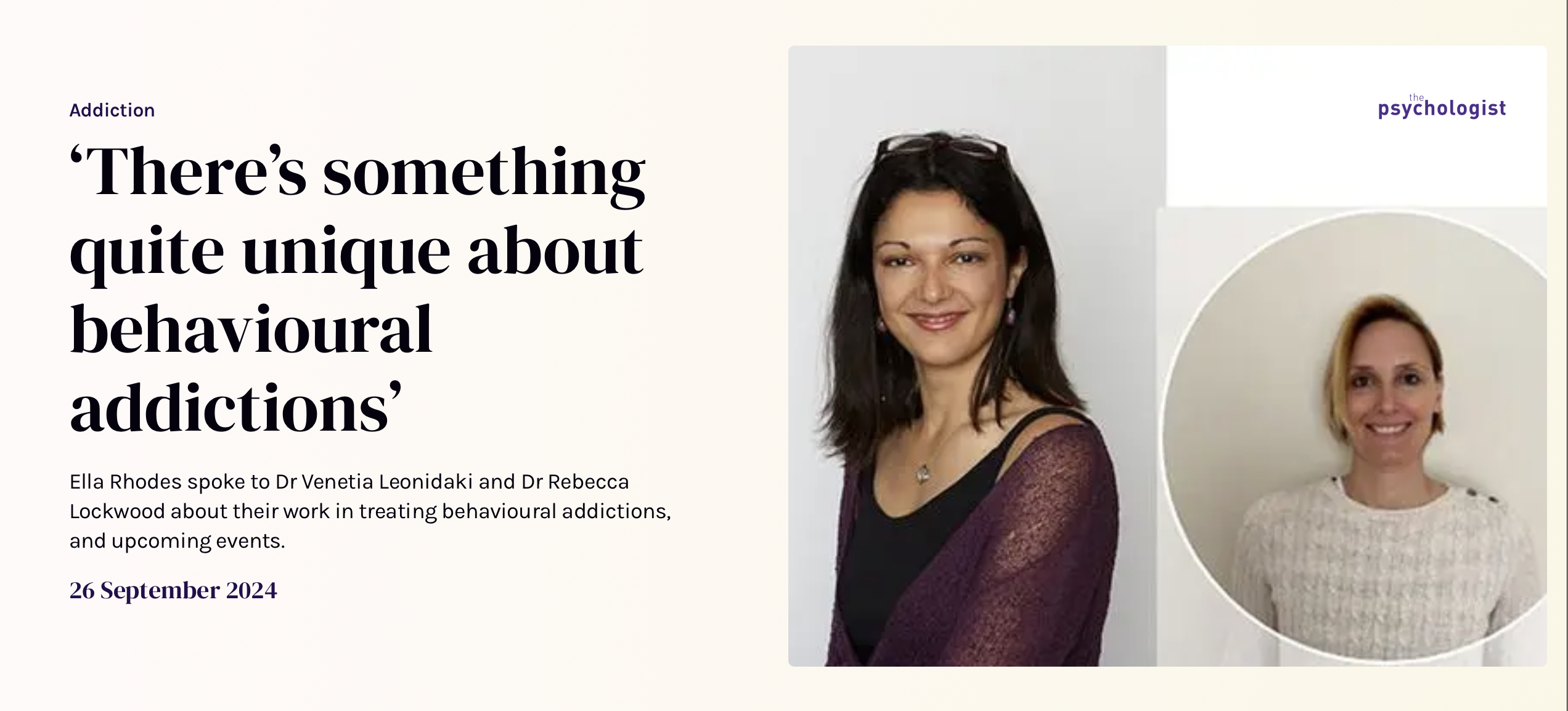
‘There’s something quite unique about behavioural addictions’ Ella Rhodes spoke to Dr Venetia Leonidaki and Dr Rebecca Lockwood about their work in treating behavioural addictions, and upcoming events.

#NPsychPick of the Month: “There’s something quite unique about behavioural addictions”

Ella Rhodes spoke to Dr Venetia Leonidaki and Dr Rebecca Lockwood about their work in treating behavioural addictions, and upcoming events via The Psichologist.

Dr Venetia Leonidaki (pictured, left) is a Consultant Clinical Psychologist at the National Gambling Clinic, and Dr Rebecca Lockwood is a Consultant Clinical Psychologist at the National Centre for Gaming Disorders.

Read The Interview Here…

The Carers Way Ahead is a free web-based psychoeducation program to help families and carers learn how to respond in positive and helpful ways to challenging behaviours that their person with a brain injury may engage in.

#NPsychPick of the Month: Strategies to help families and carers manage challenging behaviour in their person with traumatic brain injury

Strategies to help families and carers manage challenging behaviour in their person with traumatic brain injury.

The Carers Way Ahead is a free web-based psychoeducation program to help families and carers learn how to respond in positive and helpful ways to challenging behaviours that their person with a brain injury may engage in.

Read More…


Efficacy of an Intensive Exposure Intervention for Individuals With Persistent Concussion Symptoms Following Concussion: A Concurrent Multiple Baseline Single-Case Experimental Design (SCED) Study.

#NPsychPick of the Month: Efficacy of an Intensive Exposure Intervention for Individuals With Persistent Concussion Symptoms Following Concussion: A Concurrent Multiple Baseline Single-Case Experimental Design Study

Efficacy of an Intensive Exposure Intervention for Individuals With Persistent Concussion Symptoms Following Concussion: A Concurrent Multiple Baseline Single-Case Experimental Design (SCED) Study.

King, Skye MSc; Stapert, Sven Z. PhD; Winkens, Ieke PhD; van der Naalt, Joukje PhD, MD; van Heugten, Caroline M. PhD; Rijkeboer, Marleen M. PhD

#NPsychPick of the Month

Abstract

Objective:

After a concussion, 1 in 3 patients report persistent symptoms and experience long-term consequences interfering with daily functioning, known as persistent concussion symptoms (PCS). Evidence suggests PCS is (partly) maintained by anxious thoughts about brain functioning, recovery, and experienced symptoms, leading to avoidance behaviors, which may prevent patients from meeting life demands. We aimed to investigate the efficacy of a newly developed intensive exposure intervention for individuals with PCS after concussion aimed to tackle avoidance behavior.

Setting:

Participants took part in the intervention at the Maastricht University faculty.

Participants:

Four participants who experienced PCS after concussion partook in the exploratory study. Participants’ age ranged between 20 and 32 (mean = 26.5, SD = 5.9) years, with an average length of time after the concussion of 9.8 months.

Design:

A concurrent multiple-baseline single-case design was conducted. The baseline period (A phase) length was randomly determined across participants (3, 4, 5, or 6 weeks). The exposure intervention (B phase) was conducted by psychologists over a 4-week period and consisted of 3 stages: exploration (2 sessions), active exposure (12 sessions conducted over 1 week), and 2 booster sessions.

Main Measures:

Participants answered daily questions on a visual analog scale related to symptom experience, satisfaction with daily functioning, and degree of avoidance of feared activities. Additional outcomes included symptom severity, catastrophizing, fear of mental activity, anxiety, depression, and societal participation.

Results:

Tau-U yielded significant effects (P < .05) for all participants on all measures when comparing baseline and intervention phases. The pooled standardized mean difference was high for all measures (symptom experience = 0.93, satisfaction of daily functioning = 1.86, and activity avoidance = −2.05).

Conclusions:

The results show efficacy of the newly developed intensive exposure treatment for PCS after concussion, which is based on the fear avoidance model. Replication in a larger heterogeneous sample is warranted and needed.

Read More…

#NPsychPick of the Month: Mood Tracker: A Randomized Controlled Trial of a Self-Monitoring Intervention for Emotional Distress After Traumatic Brain Injury

Mood Tracker: A Randomized Controlled Trial of a Self-Monitoring Intervention for Emotional Distress After Traumatic Brain Injury.

Sherer, Mark PhD; Juengst, Shannon PhD; Sander, Angelle M. PhD; Leon-Novelo, Luis PhD; Liu, Xiangyi MS; Bogaards, Jay MA; Chua, Wilma BBA; Tran, Kim MA

#NPsychPick of the Month

Abstract

Objective:

Persons with traumatic brain injury (TBI) frequently experience emotional distress (ED) manifested in anxiety and depression. However, they may not access mental health services due to external (eg, access, transportation, and cost) or internal (eg, stigma and discomfort with traditional counseling) barriers. Based on substantial literature indicating that self-monitoring can ameliorate several health conditions, we conducted a randomized, parallel group, wait-list control (WLC) trial of a self-monitoring intervention to decrease ED after TBI.

Setting:

Community in the southwestern United States.

Participants:

Persons with medically documented complicated mild, moderate, and severe TBI.

Design:

About 127 participants were randomized in blocks of 6 to an active treatment (AT) group, wherein they completed multiple assessments of ED each week over a 6-week period via a smartphone app, or a WLC group in a parallel group, controlled trial. Participants received weekly support calls to promote self-monitoring of ED using ecological momentary assessment.

Main Measures:

ED (Patient Health Questionnaire—9 and Generalized Anxiety Disorder—7), Satisfaction with Life Scale, and Participation Assessment with Recombined Tools—Objective.

Results:

Analysis of the primary study outcome at 6 weeks after initiation of treatment for the AT group did not demonstrate that self-monitoring was effective in decreasing ED as compared to the WLC group. Brief support calls made weekly to promote compliance with self-monitoring were effective in achieving the target number of self-assessments. About 80% of support calls lasted less than 5 minutes. Greater ED was associated with lower life satisfaction and lower participation indicating the importance of addressing ED in persons with TBI.

Conclusion:

Additional work is needed to develop nontraditional interventions to circumvent barriers that prevent persons with TBI from accessing care for ED. Brief support calls may be an effective, low-cost intervention to improve compliance with self-monitoring or self-management interventions.

Read more…

Psychedelic-assisted Psychotherapy in 3-D: Acceptance, Connectedness, and Defensiveness

#NPsychPick of the Month: Psychedelic-assisted Psychotherapy in 3-D: Acceptance, Connectedness, and Defensiveness: Neuropsychoanalysis: Vol 25, No 2.

Psychedelic-assisted Psychotherapy in 3-D: Acceptance, Connectedness, and Defensiveness.

Lawrence Fischman.

#NPsychPick of the Month

Abstract

As psychiatry weighs a move from a categorical to a dimensionally-based classification system, clinical research and treatment paradigms may shift towards identifying which dimensions of mental health can improve treatment outcomes across a broad range of diagnostic categories. Psychedelic-assisted psychotherapy, which is currently in clinical trials for a wide range of conditions from PTSD to tobacco dependency, holds promise for just such a dimensional approach to treatment. Anecdotal reports and qualitative studies have hinted at its potential for decreasing defensiveness and increasing feelings of acceptance and connectedness. In this theoretical paper, I draw upon ideas and research with psychedelics, infant observation, social psychology, and psychoanalysis to explain why psychedelic-assisted psychotherapy is especially well-suited for addressing these dimensions of mental health. Because studies already support the use of psychedelic-assisted psychotherapy in one dimensionally-based application – the treatment of existential anxiety in patients with cancer – I begin with a look at psychological models of defensiveness in relation to the fear of death. I then use the models of Winnicott, Stern, Carhart-Harris/Friston and others to discuss the experiences of awe, omnipotence, and creativity within ordinary and psychedelic states, and touch on a fourth dimension of mental health, authenticity. I suggest psychedelic-assisted psychotherapy may be viewed as a transitional space ideally suited for working through experiences of disconnection through the process of illusion-disillusionment, allowing gradual acceptance. I conclude with a summary of how acceptance, connectedness, and defensiveness are related to each other and to one’s sense of self.

Read more…

1 2
Facebook
Twitter
LinkedIn